Breakaway Ad

There's an ad hiding in your business that your competitors pray you never make.

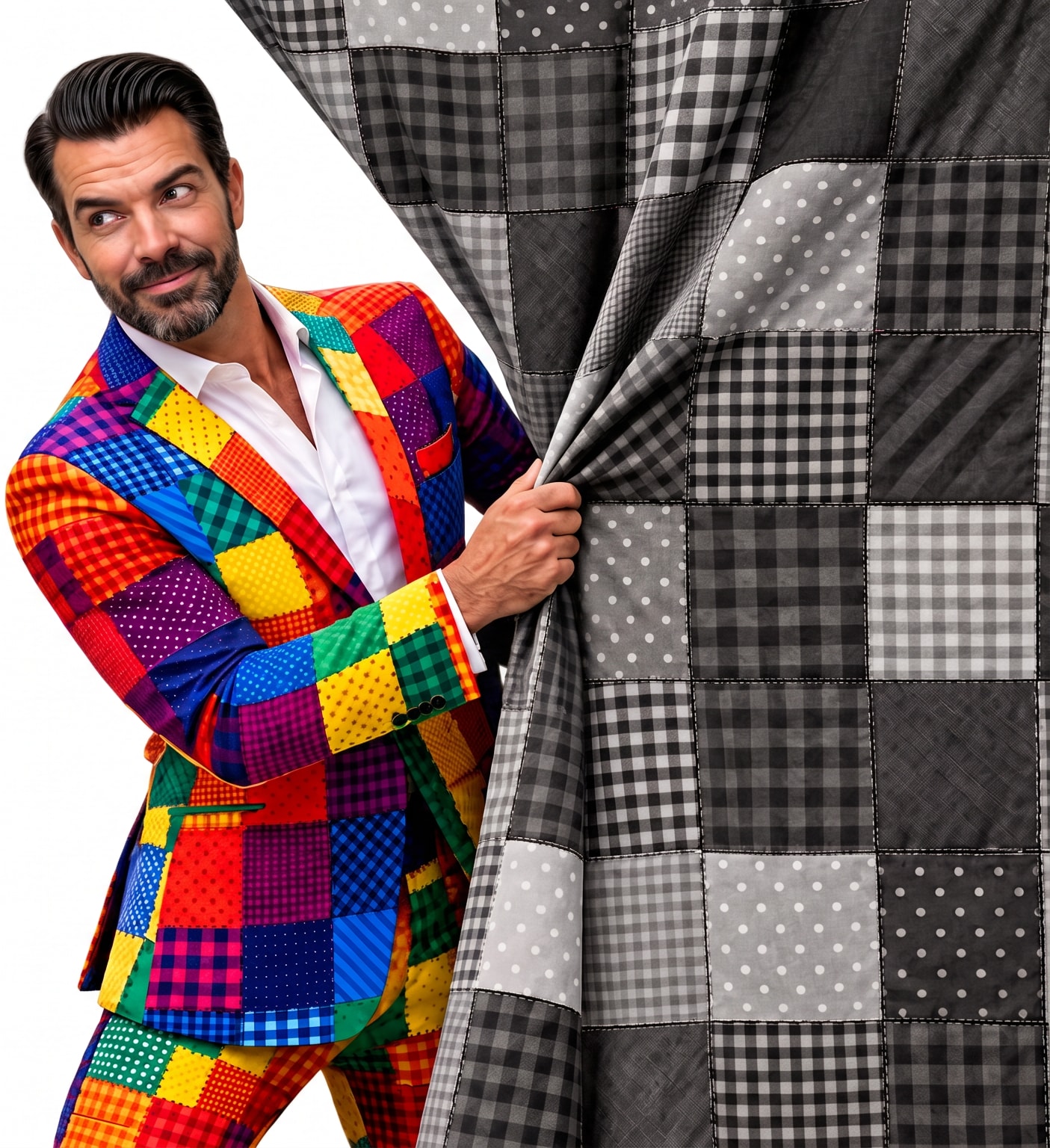
A man in a rainbow patchwork suit draws a grey patchwork curtain aside and glances back over his shoulder with a half-smile.
A man in a rainbow patchwork suit strolls across an empty crosswalk while a crowd of commuters in grey waits on the kerb under a red WAIT signal, staring at him.

Let's skip the part where I play the internet guru who insists you're in trouble.

We both know you're not.

  • The lights are on.
  • The dashboard is blinking green.
  • You're hitting your targets.
A man in a rainbow patchwork suit strolls across an empty crosswalk while a crowd of commuters in grey waits on the kerb under a red WAIT signal, staring at him.

You're powering your way through that Amazon best-seller list for business owners, and (unlike those cosplay CEOs on LinkedIn) actually putting the ideas to work.

Your accountant keeps sneaking off to the bathroom with a copy of your financials, and you're the successful buddy that your buddies brag about to their other buddies.

By their standards, you're shooting the lights out.

By yours, you're just getting warmed up.

You're not in this for a golf clap at the end of Q4.

You don't compare yourself to the competitor down the street.

Nope. You're a maniac who wants your face carved into a mountain next to the all-time greats.

It's a thirst for legacy, and no amount of revenue has managed to quench it yet.

And the gap between here and there keeps showing up, especially in your ads.

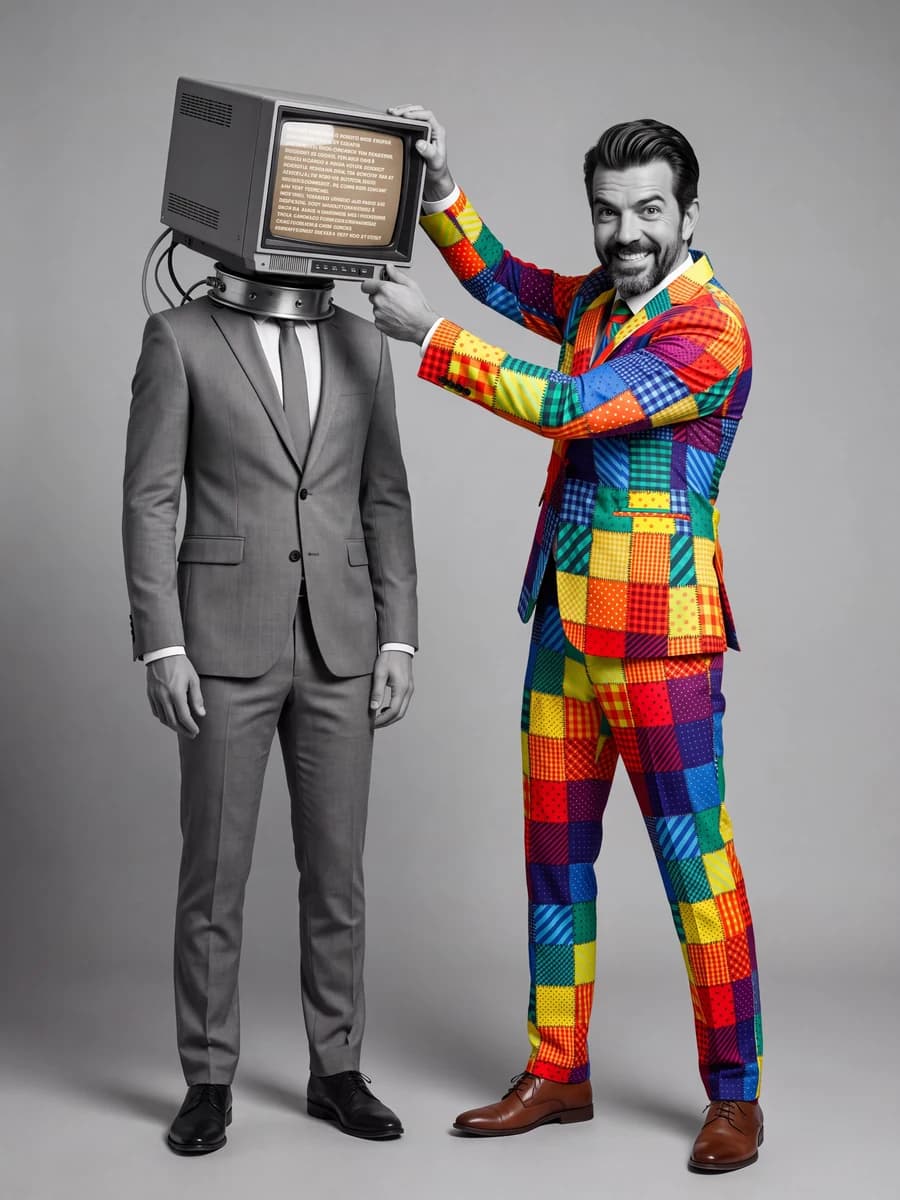
A grinning man in a rainbow patchwork suit twists a teleprompter monitor off the shoulders of a faceless client in a grey suit, like a jar lid.

Your brand's colossal charisma has been stuffed into a small grey suit and plonked in front of a hand-me-down teleprompter still loaded with your competitor's script.

Signing off on those ads feels like self-betrayal.

You know a great ad when you see one.

It doesn't matter if it's peddling a twelve-dollar perfume for your porcelain or a bare-bones razor shipped in a brown box.

Those ads don't pine for your attention. They snatch it.

They slip past your BS filters and jab you right in the chest.

That's what you want for your brand.

  • Not the next big "secret growth hack."
  • Not some 14-step tripwire funnel cobbled together by a kid in his mom's basement.

You crave an ad so outrageous that your pay-per-click guy goes pale, and so evocative that your gut lights up like Times Square on New Year's Eve.

You secretly fantasize about that ad your industry lacks the nerve to make.

  1. It drops on a Tuesday morning, and by lunch your phone's buzzing like a swarm of honey bees.
  2. Across town, your copycat competitor just spat his coffee all over his underpriced invoices.
  3. Your team's passing it around like contraband.

Your best client texts you one word:

"Legend."

  • The tire-kickers? Gone.
  • The nickel-and-diming? Stopped mid-sentence.

Callers stop asking "What's the difference?" and start asking "When can I have it?"

At the next barbecue, one of your buddies quotes your ad back to you…

Word for word, even doing the voice.

Feels good, doesn't it?

So why haven't you created an ad like that yet?

I bet it's not for lack of trying.

I'm guessing you've thrown a lot at the wall, praying it would stick.

  • Maybe you wrote the big checks and hired the agency with the exposed brick office and the nine-thousand-dollar espresso machine.

  • Chances are, you sat through at least one "brand workshop" with some consultant in a Patagonia vest drawing Venn diagrams on a whiteboard.

  • Maybe you bought some internet guru's frameworks. You might've even paid for the 90-day content calendars.

But after all that spending, tending and bending, you're sitting on something… sadly familiar.

And here's the absolute worst part: if you peeled off your logo and slapped your biggest competitor's right in its place, your ideal buyer wouldn't even be able to tell the difference.

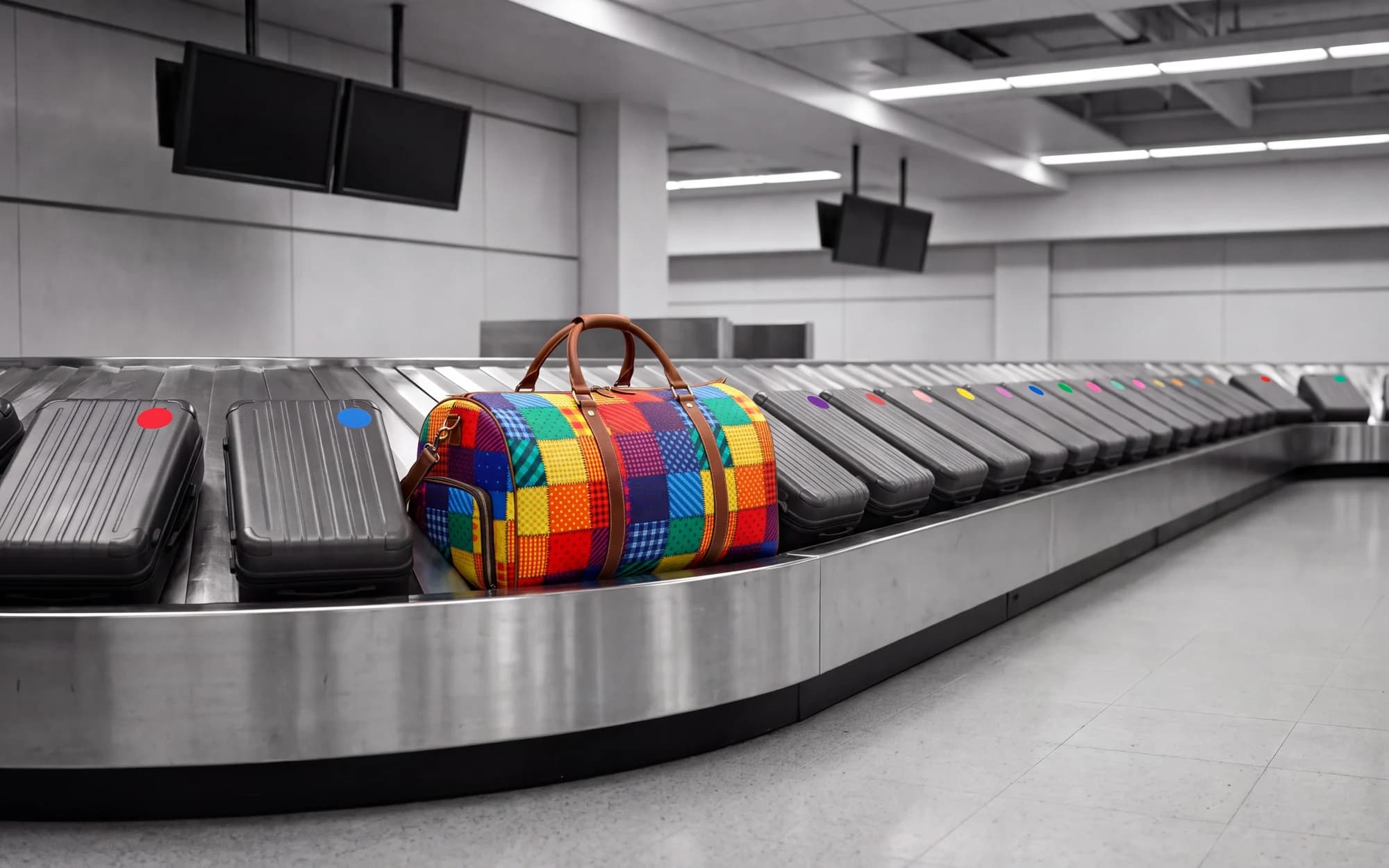
An airport baggage carousel of identical grey suitcases, each marked with a different coloured dot, with one rainbow patchwork holdall riding among them.

Which leaves you wondering: what does it actually take to make the ad your industry's too chicken to make?

You didn't break any rules (and that's the problem).

  • Playing by the rules is exactly how you built a heavyweight business.
  • And following best practice in operations and finance is very smart.

But great marketing demands going in a different direction. Follow your industry's best practices in advertising, and you're in the fast lane to invisible and forgettable.

You're not out on the open road. You're stuck in the middle of the peloton…

A tightly packed bunch of cyclists in identical grey kit, shot side-on with motion blur, with one rider in a rainbow patchwork kit boxed in among them.

Fifty elite guys in skin-tight neon spandex on a narrow strip of asphalt, all hunched over fifteen-thousand-dollar carbon-fiber bikes that were meticulously engineered in a Swiss wind tunnel to eliminate a fraction of a drag coefficient.

And what are they doing with all that elite technology?

The exact same thing as the guy right next to them.

Holding the exact same wheel. Keeping the exact same cadence. Pedaling at the exact same rhythm.

So let yourself off the hook. You haven't lost your edge. Holding your spot in that pack, boxed in by everybody else's playbook, takes serious legs.

But let's call it what it is: you're keeping pace in spite of your industry's "best practices," not because of them.

That's an awful lot of effort to spend blending in.

So who benefits from you staying boxed in?

For starters, the Advertising Industrial Complex. That entire machine is engineered to keep you in the middle of the pack.

I know, because I spent years inside it.

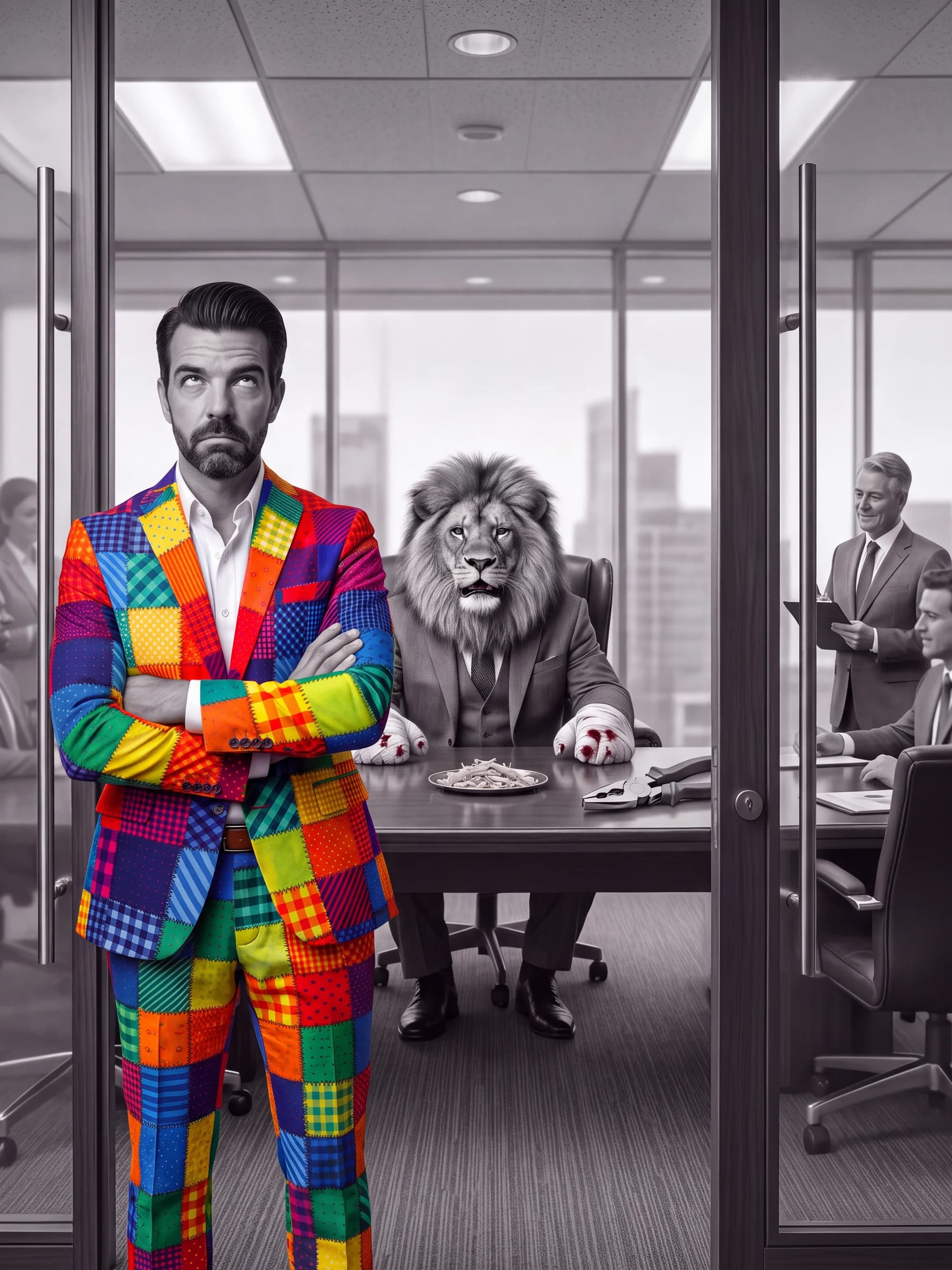
A man in a rainbow patchwork suit stands in a boardroom doorway with his arms folded and his eyes rolled upward; behind him a declawed, toothless lion in a grey suit sits at the table beside a pair of pliers while an executive nods along.

On the commercial side of a global agency, I sat across the polished mahogany from giants like P&G, Mars and L'Oréal. I lost count of the times I watched the ad equivalent of The Empire Strikes Back get whittled down by committee until it had the sex appeal of a Microsoft user manual.

And the agency, desperate to protect that fat monthly retainer, would just roll over and show its belly.

The Fortune 500 can survive that kind of cowardice. With a billion-dollar media budget, you can bludgeon your way into people's heads through sheer brute force repetition.

You don't have the billion-dollar hammer. The agencies sell you the same declawed playbook anyway, and without the hammer it just dissolves into background noise.

Beautiful racket, really. They cash your retainer and make sure your marketing never gets loud enough to bother the whales.

And your industry rivals are on their knees praying you keep playing nice. Because as long as you hold the same line as every other hypnotized rider in the peloton, they get to keep scavenging your market share on a 50/50 coin toss.

But they know something you might not.

The second you break that cadence, get up out of the saddle and go, it's over. They haven't got the legs to follow.

That's the opportunity sitting in front of you right now.

Here's where you choose your line.

"Close your eyes and picture where your business will be in five years…"

…says every consultant with a whiteboard.

But if you refuse to change your cadence, you don't need a vision board to see the future. The physics of the peloton guarantee it.

You stay tucked in the draft. You hammer the pedals just to blend in with the pack. You watch competitors who offer less siphon off great clients on a coin toss.

Your revenue survives, but you can forget about your face on a mountain with the greats.

Or… you attack.

You get up out of the saddle, find the line nobody else is riding, and go. One ad that says the thing your industry won't, and suddenly there's daylight between you and the pack. Then more daylight. Then the pack becomes somebody else's problem.

That's how faces end up on mountains.

Just know you can't pull a move like that on a copy-and-paste commuter bike.

How do you gap the peloton?

Your business has a definitive, pack-splitting point of view.

But somewhere along the line, the Advertising Industrial Complex got hold of it. They bleached the message until you got bunched in and beiged out.

Breaking away means pushing into the headwind to reclaim that position. It takes nerve to step out of the slipstream and say the thing your competitors haven't got the stomach to say.

But that nerve pays off.

The copycats can steal your pricing model. They can rip off your features and benefits.

They can't counterfeit a definitive point of view.

But what do you actually do with that point of view?

You make the market look at it. Harder than it sounds, because the market is busy. It's scrolling with one thumb, eating a sandwich with the other hand, and half-watching a dog on a skateboard.

So a Breakaway Ad has to pull off three moves.

  1. Hijack the scroll.

    Something unexpected, or a truth so specific it could only be about them. The thumb stops before the brain has decided whether it wants to.

  2. Hit them where they live.

    Your buyer will happily justify the purchase with logic later. But it's a feeling that makes them lean in first: a laugh, a wince, a nod so hard they nearly pull something. Get them feeling, and they forget they're being sold to.

  3. Call out the whole industry.

    Plant your flag. Name the rules everyone else plays by and show why they're broken, until choosing the other guy feels like ordering the sad desk salad.

Now, the tricky bit: all three have to happen at once, in roughly the time it takes to read this sentence twice.

That's a Breakaway Ad. It catches your industry flat-footed and has you off the front before anyone's clipped in.

I can hear the objection already.

"Sounds great. But my industry is different. My buyers are too serious for this."

I've heard that in more than 50 industries.

  • Clinical diagnostics.
  • Trucking.
  • Industrial chemicals.
  • Commercial engine components.

Every one was certain it was the exception. None of them were.

A serious industry isn't a reason to be boring. It's the reason you can't afford to be. When buyers are bored, they stop looking for the best and default to the cheapest.

The Breakaway Blueprint is new, so rather than invent testimonials, here's the principle at work in four businesses that stopped sounding like their category. (Not my clients, to be clear. Just proof of what happens when someone's brave enough.)

  1. The commodity: Dollar Shave Club.

    Razors had been sold with celebrity athletes and giant TV budgets. Dollar Shave Club made a deadpan video for about $4,500 that poked fun at the giants' pricing. It pulled around 12,000 orders in 48 hours, and Unilever later bought the company for a reported $1 billion.

  2. The invisible B2B service: Slack.

    Workplace software was sold like a technical manual. Slack's launch video was a deadpan mockumentary about a video studio that swore "products like that never work," then fell in love with it anyway. It treated corporate buyers like humans who enjoy being entertained, and racked up more than a million views, for a product demo. Salesforce later bought Slack for $27.7 billion.

  3. The unmentionable product: Poo~Pourri.

    Bathroom odour was sold with clinical ads that tiptoed around the subject. Poo~Pourri put an elegant woman on a toilet and let her be razor-sharp funny. The video hit six million views in its first week, finished 2013 as one of YouTube's five most-watched ads, and the brand has since sold more than 60 million bottles.

  4. The telecom underdog: Mint Mobile.

    Wireless was a saturated market with brutal acquisition costs. Mint used self-deprecating humour to mock the big carriers' bloated ad budgets, and T-Mobile later acquired it in a deal reported at up to $1.35 billion.

Different industries. Same truth. When an idea hits a nerve, people share it for you, so every eyeball costs you less while the pack keeps paying full price.

Your business is almost certainly more interesting than prepaid phone plans. The only question is whether you're ready to let the market see it.

What does breaking industry advertising rules look like?

Here's a taste: nine industries, about five seconds each, and zero well-worn clichés.

How do we put this in your hands?

If I ran a traditional agency, this is where I'd slide a twelve-month contract across the mahogany and invoice you twenty grand before you'd seen a single idea.

A man in a rainbow patchwork suit leans against a desk with a marker held to his lips, thinking, in front of a board covered in bold hand-drawn ad concepts.

I don't do that. I run a studio, and it does one thing: finds your point of view and turns it into a Breakaway Ad.

But nobody attacks blind. Before you spend a dollar on production, we map the road: where the gap is, when to go, and how hard.

That's The Breakaway Blueprint.

And no, there's no fifty-question branding quiz. Nobody's going to ask what kind of tree your business would be.

It's one recon, one working session, and one Blueprint on your desk forty-eight hours later.

  1. The Recon.

    Before we talk, I binge your entire category like it's a true-crime documentary. Every ad your competitors run, every cliché they lean on, every formula they borrowed off each other. I'm looking for the road they all abandoned, because that's usually where your point of view has been waiting.

  2. The Session.

    Ninety minutes, just you and me. No account managers nodding along on mute. You talk; I ask the uncomfortable questions. You don't need to be a marketing whiz. You just need to know why your best buyers keep choosing you, even if you've never managed to put it into words. That part's my job.

  3. The Blueprint.

    Forty-eight hours later, it's in your inbox, in four parts:

    • The Angle.

      The point of view nobody in your industry has had the spine to claim. Own it, and price stops being the conversation.

    • The Ecosystem.

      Where your current sales setup leaks. There's no point pouring premium buyers into a bucket with holes in it. The ad creates the demand; this makes sure you keep it.

    • The Signatures.

      The sound, look and texture that make the ad unmistakably yours. Anyone who copies it just looks like a tribute act.

    • The Storyboard.

      The ad, roughed out frame by frame, so you see exactly how it rides before you spend a dollar making it.

  4. The Choice.

    The Blueprint's yours. Hand it to your current team and tell them to build it. Or, if you'd rather nobody else touch it, my studio produces The Breakaway Ad. That starts at $4,950 for the hero commercial, platform cut-downs with subtitles, and three static campaigns built from the same DNA. Your media buyer runs it, or I'll introduce you to mine.

But that's a conversation for later. Today, we find the gap.

The Breakaway Blueprint is $495.

You didn't build a business like yours by missing the obvious, so you're probably wondering why the plan for a premium asset costs less than your accountant charges to glance at your tax return.

Honest answer: it's an audition. For both of us.

Here's how I figure it goes. You read the Blueprint, you see the gap, and you realize you don't want anyone else's fingerprints on it. Book The Breakaway Ad within thirty days and I knock the $495 off the production invoice, so the Blueprint costs you nothing.

And if you take it and walk? No hard feelings. You leave with the clearest picture you've ever had of what makes your business impossible to copy, and you can build it with whoever you like.

How does this compare to your other options?

You've got three. The math isn't complicated.

  1. Option One: The Bloated Model.

    You go the traditional route. You sign a twelve-month retainer, wire a ten-thousand-dollar deposit, then wait six weeks for an agency to guess why your customers buy.

  2. Option Two: The Rut.

    You do nothing. You keep pouring money into beige camouflage and watch louder competitors with a fraction of your talent land your premium clients. Doing nothing feels free. It's the most expensive option on the table.

  3. Option Three: The Breakaway.

    $495 and ninety minutes, for a Blueprint built on the point of view that gets your buyers moving. One ad that brings in premium buyers without price resistance covers it several times over.

The risk isn't $495.

It's another twelve months watching someone with half your talent become the name your market says first, just because they moved first.

The Prerequisites

Before You Clip In

This isn't for you if you're still testing your first idea. The Breakaway Blueprint needs an established business underneath it, so four things need to be true before I start the recon.

  1. The Offer.

    You sell something premium, buyers pay for it, and you know your margins. We're not here to invent your business model. We're here to build the ad that makes it impossible to ignore.

  2. The Capacity.

    Your operations can take the weight. If a Breakaway Ad sends a surge of premium buyers your way, delivery or fulfilment doesn't buckle.

  3. The Authority.

    You're the owner, and you make the call. No board of directors, no marketing committee. You read the Blueprint and you decide.

  4. The Gap.

    You can feel the ceiling on your current positioning. You've watched lesser operators win just because they're louder. You might not be able to name your point of view yet, but you've run out of patience for beige marketing.

Let's find out if we're a fit before you spend a dollar.

A man in a rainbow patchwork suit holds a phone to his ear and a single colourful jigsaw piece up to the window light, above a grey puzzle with one piece missing.

Before you book anything, we get on a fifteen-minute call. No slide deck, no "discovery process" that turns out to be a sales ambush in a nice shirt.

You tell me where your business is and where you want it to go. I ask a few pointed questions about your category. By minute fifteen, we'll both know whether there's a breakaway worth chasing.

If there is, I'll send you the link to book your Blueprint. If there isn't, I'll tell you straight, and probably point you somewhere more useful.

And yes, I'm listening for fit too. I'll be checking the four prerequisites above, so have a think about them before we talk. If it turns out you want a rubber stamp for your beige marketing rather than a Breakaway Ad, I'll say so on the call and save us both the trouble.

Look, I don't hand your business off to a twenty-two-year-old account manager, so I only do five Blueprints a month. I'd rather spend them on people who actually want to leave the pack.

The Next Move

Here's how you get started:

  1. Click the button below and grab a fifteen-minute fit call.

  2. If we're a fit, I'll send your booking link. Give me the bare mechanics of your business at checkout, and I'll start the recon on your category.

  3. We meet for the ninety-minute Session.

  4. Within forty-eight hours, the Blueprint lands in your inbox.

P.S. That ad your competitors pray you never make? Somebody in your market is going to make their version first. Fifteen minutes on the phone tells us both whether that somebody gets to be you.

Book your 15-minute fit call

Book your 15-minute fit call

Loading